

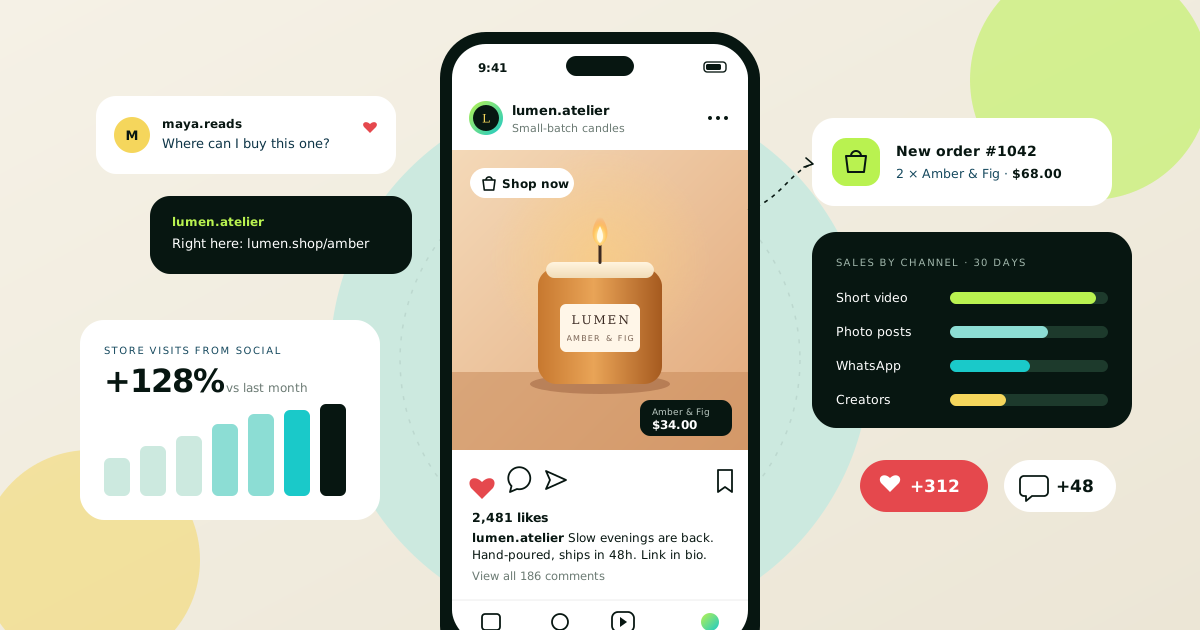
Social media is the cheapest way for a small brand to be seen in 2026, and the most misused. Most businesses post when they remember, copy what big brands do, count likes, and conclude that "social doesn't work for us."
It does work, when you treat it as a system with one job: bring the right people to the place where they can buy. This guide gives you that system, from choosing a platform to measuring what actually turns into sales. It works whether you sell products online, run a local business or are building a personal brand.
Why social media still matters for small businesses
More than 5 billion people use social media worldwide (DataReportal), and for most of them it is where they discover new products, ask for recommendations and check whether a brand is real before buying.
For a small business, that gives social media three jobs:
- Discovery: people who have never heard of you find you through a video, a share or a search inside the app.
- Trust: a prospect who lands on your store checks your profile. An active account with real customers says "this business exists and delivers."
- Retention: followers who bought once see your new products and come back without you paying for an ad.
Notice what is not on the list: vanity. Followers are only useful if some of them become customers.
Step 1 — Define your brand before you post
Social content without a clear brand is noise. Before opening any app, write down three things in one sentence each:
- Who you serve: "busy parents who want healthy snacks for kids", not "everyone".
- What you promise: the result or feeling your product gives.
- How you sound: two or three words (warm and funny, expert and calm, bold and direct).
Then fix your visual basics: a logo that reads at small sizes, two or three brand colors, one or two fonts. Use them on every post so that someone scrolling recognises you before reading your name.
Step 2 — Choose the right platforms (not all of them)
The most common mistake is opening an account everywhere and abandoning them all within a month. Start with one main platform and one secondary, chosen by where your buyers already are.
| Platform | Best for | Content that works | Buying intent |
|---|---|---|---|
| Fashion, beauty, food, home, lifestyle brands | Reels, carousels, Stories, behind the scenes | High: people expect to shop | |
| TikTok | Products with a visual "wow", young audiences, trends | Short, raw, authentic vertical video | High for impulse buys |
| Local businesses, audiences over 35, communities | Groups, events, Marketplace, video | Medium to high, strong for local | |
| YouTube | Products that need explaining, expertise, tutorials | Long-form guides and Shorts | High: viewers are researching |
| Home, weddings, DIY, fashion, recipes | Vertical images linking to products | Very high: people plan purchases | |
| B2B services, founders, professional products | Text posts, lessons, case studies | High for B2B, low for consumer goods | |
| Direct conversations, repeat customers, local sales | Status updates, catalog, broadcasts | Very high: the conversation is the sale |
A simple rule: if your product looks good in a 10-second video, start with Instagram or TikTok. If it needs explaining, start with YouTube. If you sell locally, start with Facebook and WhatsApp.
Step 3 — Build content pillars
Content pillars are the 3 or 4 recurring themes your account talks about. They end the daily "what should I post?" problem and make your account coherent. Most brands can work from these four:
- Teach: tips, how-tos and mistakes to avoid in your field. A candle brand teaches how to make a candle burn evenly; a clothing brand shows three ways to style one piece. This builds trust and gets saved and shared.
- Show: behind the scenes, how products are made, packing orders, the team, your workspace. This makes you human, which big brands struggle to do.
- Prove: customer reviews, photos and videos from buyers, before and after, results. This removes doubt.
- Sell: product launches, offers, restocks, limited editions, with a clear call to action.
A healthy mix is roughly four posts that give value for every one that sells. Accounts that only sell get ignored; accounts that never sell never make money.
Step 4 — Create content that people actually watch
Lead with short vertical video
In 2026, short vertical video (Reels, TikTok, YouTube Shorts) is still the format platforms push hardest to people who don't follow you yet. That makes it your main tool for discovery. Photos, carousels and Stories are better for engaging the followers you already have.
Hook in the first two seconds
Most viewers decide almost instantly whether to keep watching. Open with the most interesting part, not your logo:
- A result: "This is what $12 of fabric became."
- A problem: "Your candles tunnel because of this one mistake."
- A surprise: the finished product first, then how it was made.
Keep it simple and real
You don't need a studio. A recent phone, natural light by a window and clear sound are enough. Raw, honest videos often outperform polished ads because they look like the rest of the feed.
Batch your production
Pick one session a week to film and write everything: 3 to 5 short videos, a few photos, captions. Then schedule them. Batching is what makes consistency possible when you're also running the business.
Step 5 — Post consistently and engage
Consistency beats volume. Three good posts a week for six months will do more for your brand than daily posts for three weeks followed by silence. Pick a rhythm you can hold:
- Starting out: 3 posts a week on your main platform, Stories most days.
- Growing: 4 to 5 posts a week, plus repurposed versions on your secondary platform.
Repurpose everything. One product video can become a Reel, a TikTok, a YouTube Short, a Pinterest pin and a WhatsApp Status. Adjust the caption and the first frame; keep the idea.
Engagement is half the work. Reply to every comment and message, especially in the first hour after posting. Comment thoughtfully on accounts in your niche. Ask questions in captions. Platforms show more of your content to people who interact with you, and a reply is often what turns a curious viewer into a buyer.
Step 6 — Turn followers into customers
This is where most brands lose the value of social media: people like the post, then have nowhere easy to go. Every account needs a clear path from post → product → checkout.
- Own a real store. A link in bio to a proper storefront converts better than "DM to order", and you keep your customer list. With Cartva, every product and collection has its own link that shows a rich preview (image, title, price) when shared on Instagram, Facebook or WhatsApp.
- Link to the exact product. If the video shows the blue hoodie, link the blue hoodie, not your homepage.
- Use one call to action per post: "Tap the link in bio", "Comment SIZE and we'll send it", "Shop the restock before Friday."
- Sell in the conversation. Many buyers want to ask a question first. WhatsApp selling lets you answer and send the product link in the same chat.
- Give a reason to act now: a launch-week discount code, a limited run, free shipping until Sunday. Create codes in your dashboard; see discounts and promotions.
- Capture the relationship. Invite buyers and followers to your email list or WhatsApp broadcast, so a change in the algorithm can't cut you off from your audience.
Step 7 — Work with creators and your own customers
The fastest trust builder is someone else saying your product is good.
- Micro-creators (a few thousand to a few tens of thousands of followers) usually have more engaged audiences than big influencers and are open to product-for-content deals or a commission on sales.
- User-generated content: ask every customer to post a photo or video, and repost the best with permission. Include a small card in the package asking for it.
- Affiliate links: paying creators a commission per sale means you only pay for results. If you want to understand how that model works from the creator's side, see how recurring commissions work in ecommerce affiliate marketing.
Step 8 — Use paid ads only once organic content works
Ads amplify what already works; they don't fix content nobody wants. The simple approach:
- Post organically for a few weeks and watch which posts get saves, shares and link clicks.
- Put a small daily budget behind your best organic post, targeted at people similar to your customers.
- Retarget people who visited your store but didn't buy.
None of this works without tracking. Install the Meta Pixel and Google Analytics on your store before spending a dollar; on Cartva you just paste the IDs in your settings (see tracking pixels setup).
Step 9 — Measure what matters
Ignore follower count as a goal. Watch these instead:
| Metric | What it tells you |
|---|---|
| Reach from non-followers | Whether your content is being discovered |
| Saves and shares | Whether people find it valuable enough to keep or pass on |
| Profile visits and link clicks | Whether content creates interest in the brand |
| Store visits by channel | Which platform actually sends traffic |
| Orders and revenue by channel | Which platform actually makes money |
Review once a month: keep doing what brings visits and orders, drop what only brings likes.
Common social media mistakes to avoid
- Being on every platform badly instead of one platform well.
- Only posting ads. Nobody follows a catalog.
- Ignoring comments and messages — they are your warmest leads.
- No link to buy, or a link to a homepage where the product is hard to find.
- Quitting after a month. Social media compounds; the first 90 days are the slowest.
- Buying followers. Fake accounts never buy and they hurt your reach with real ones.
Frequently asked questions
Which social media platform is best for a small business?
The one where your buyers already spend time. Instagram and TikTok suit visual consumer products, Facebook and WhatsApp suit local businesses, YouTube suits products that need explaining, Pinterest suits planned purchases like home and weddings, and LinkedIn suits B2B services.
How often should a business post on social media?
Start with about three posts a week on your main platform, plus Stories most days, and keep that rhythm for at least three months. Consistency matters more than volume.
How do you turn social media followers into customers?
Give every post a clear next step to a store you own: link to the exact product, use one call to action, answer questions in comments and messages, and offer a reason to buy now, like a launch discount or limited stock.
Do I need to pay for ads to grow on social media?
No. Organic content can grow a brand on its own, especially short vertical video. Ads are most useful once you know which organic posts work, to show them to more people similar to your customers.
How long does it take to see results from social media?
Most small brands need around three months of consistent posting before seeing steady traffic and sales. Early results come faster when you engage actively and post short video.
Can I sell directly from Instagram, TikTok or WhatsApp?
Yes. You can link to your own store from your bio, posts and Stories, and send product links in messages. Owning the store means you keep the customer data and aren't dependent on one platform's rules.
Start turning posts into sales
Social media brings people to your door; your store is where they buy. Create your Cartva store — 30 days free, no card — and every product gets a shareable link ready for your bio, your posts and your WhatsApp chats. Still choosing what to sell? Read how to start print on demand in 2026.